


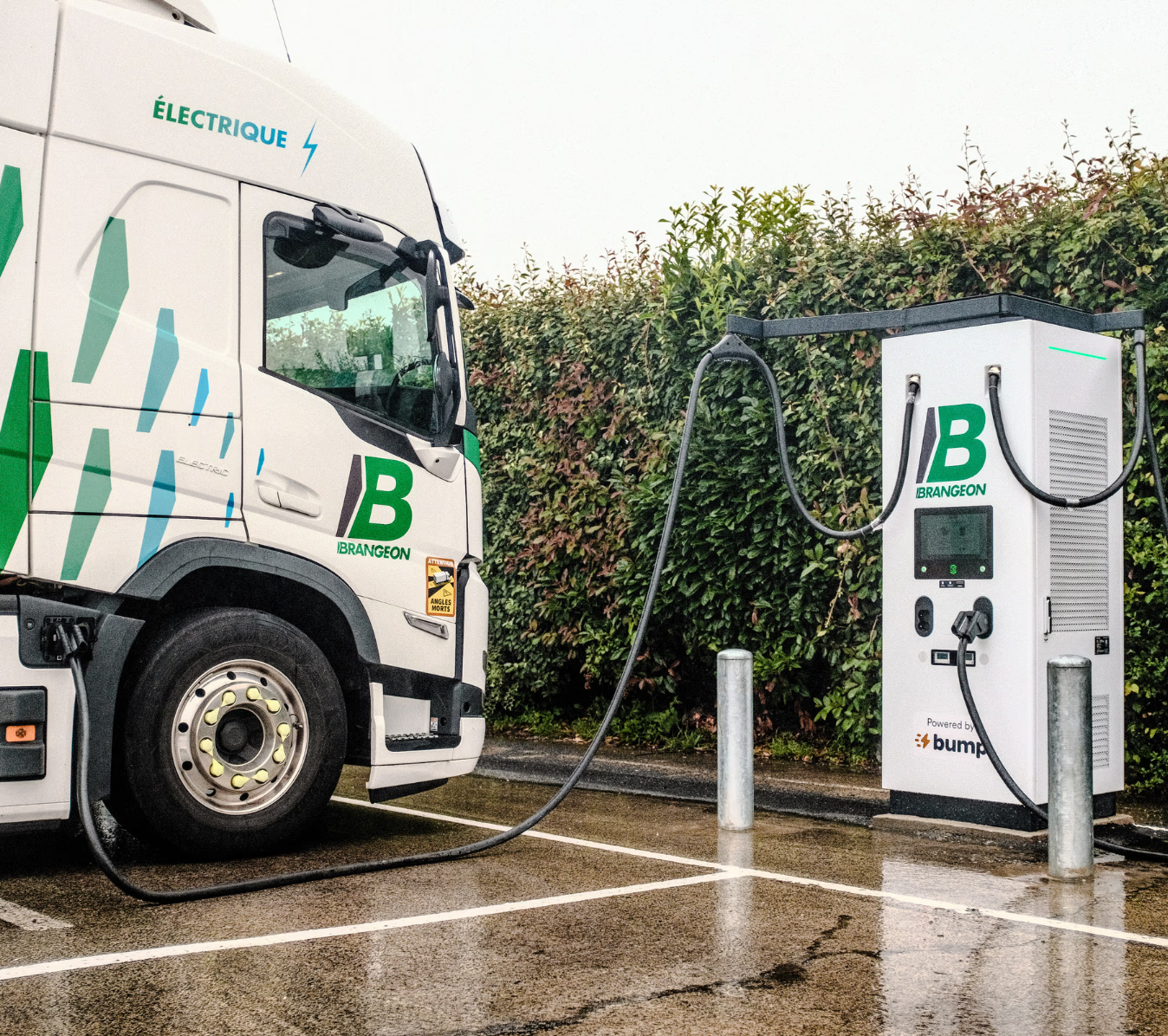
Le Parlement européen vient de publier son bilan du règlement Afir. Un chiffre résume l'essentiel : sur 22 500 camions électriques en circulation en Europe, seulement 2 000 bornes sont réellement dimensionnées pour les poids lourds. Ce gap n'est pas une surprise, c'est un signal que l'infrastructure ne suit pas le rythme du parc. Et pourtant, la transition est là, concrète, irréversible.
22 500 camions électriques en circulation en Europe
2 000 bornes vraiment adaptées aux poids lourds
20 000 points de recharge HDV visés d'ici 2030
L'état des lieux : un règlement ambitieux, une réalité qui décroche
L'objectif du règlement Afir (Alternative Fuels Infrastructure Regulation) est clair : atteindre 20 000 points de recharge dédiés aux camions d'ici 2030, soit une station tous les 60 km sur le réseau RTE-T. Aujourd'hui, on est très loin du compte.
Ce n'est pas que les acteurs du transport manquent de volonté. Sur le terrain, les flottes se déploient, les transporteurs s'engagent, les constructeurs livrent. La transition du fret lourd vers l'électrique est réelle. Mais sans infrastructure fiable, robuste, pensée pour les réalités industrielles des dépôts et des hubs logistiques, elle bute sur un mur.
« Le véhicule électrique, c'est l'étape 1. L'infrastructure opérée, disponible et optimisée pour le TCO, c'est l'étape qui détermine si ça fonctionne vraiment à l'échelle. »
Pourquoi l'infrastructure ne suit-elle pas ?
La réponse tient en une phrase : électrifier une flotte poids lourds, ce n'est pas installer des bornes. C'est une démarche d'ingénierie opérationnelle qui commence bien en amont du câble électrique.
- 1. Comprendre les usages réels : Quelles tournées ? Quels kilométrages quotidiens ? Quels horaires de retour dépôt ? Sans cette analyse, l'infrastructure est soit sous-dimensionnée, soit sur-investie.
- 2. Modéliser la contrainte réseau : Quelle puissance de recharge est réellement disponible au point de connexion ? Quels délais de raccordement ? Le réseau électrique amont conditionne directement l'architecture de la solution.
- 3. Optimiser le contrat d'énergie : Quel tarif d'électricité selon les heures de recharge ? La structure des coûts au kWh est l'une des principales variables du TCO. Elle se négocie et se pilote.
- 4. Dimensionner pour la montée en charge : L'infrastructure doit s'adapter à la croissance progressive du parc, sans sur-investir à l'année zéro, ni saturer à l'année trois.
C'est précisément pour répondre à ces questions que nous avons développé Elec Planner, notre simulateur gratuit dédié aux tournées PL et VUL.
Elec Planner - Votre simulateur d'électrification de flotte
À partir de vos contraintes d'exploitation réelles, Elec Planner génère une étude chiffrée complète et une vision financière sur 10 ans.
- Analyse de vos tournées et kilométrages réels
- Modélisation du besoin de recharge selon vos horaires de dépôt
- Calcul du TCO comparatif sur 10 ans (thermique vs électrique)
- Dimensionnement de l'infrastructure adapté à votre montée en charge
- Jusqu'à 35 % de réduction des coûts kilométriques identifiée
Lancer ma simulation gratuite →
La révision de l'Afir : un rendez-vous à ne pas manquer
La révision du règlement Afir est prévue d'ici fin 2026. Ce sera un moment charnière. Elle devra intégrer les nouvelles technologies de recharge : le MCS (Megawatt Charging System) en tête, et surtout établir un cadre réglementaire lisible pour que les investissements s'accélèrent massivement.
Aujourd'hui - 2 000 bornes adaptées aux PL pour 22 500 véhicules. Le déploiement des flottes devance l'infrastructure.
Fin 2026 - Révision du règlement Afir. Intégration du MCS et nouveau cadre pour accélérer les investissements.
2030 - Objectif : 20 000 points de recharge HDV, une station tous les 60 km sur le réseau RTE-T.
La méthode qui fait la différence
Sur les PL et VUL, l'électrification ne se construit pas à l'approximation. Elle se construit avec des données concrètes, une bonne compréhension des usages, et une vision claire du TCO dans la durée. Pas sur 12 mois, mais sur 10 ans.
Les camions sont là. La dynamique est là. Ce qui manque encore, c'est l'infrastructure, et les outils pour l'anticiper correctement. C'est exactement le problème que nous résolvons chez Bump, au quotidien, avec les opérateurs de transport.

Vous travaillez sur l'électrification de vos tournées ?
Notre simulateur Elec Planner vous permet de modéliser simplement vos besoins, d'identifier les leviers de réduction de coûts, et de construire un plan d'infrastructure aligné sur la réalité de votre exploitation — gratuitement, en quelques minutes.